
Hair foil thickness and alloy
Our hair foil is made in 12–20 µm, from aluminium alloy 8011 in the O temper, and the gauge is chosen for each order. The lighter end suits narrow pop-up sheets and fine weaves; the heavier end suits wide sheets and long pieces cut from a roll.
Our thickness range
Thickness is given in microns (µm). One micron is one thousandth of a millimetre. The table gives the range we make for each format, with the alloy and temper of the foil; the gauge for your order is chosen within it, to suit the size and the technique.
| Format | Thickness | Alloy | Temper |
|---|---|---|---|
| Pop-up hair foil | 12–20 µm | 8011 | O |
| Pre-cut hair foil sheets | 12–20 µm | 8011 | O |
| Hair foil rolls | 12–20 µm | 8011 | O |
| Wide and extra-wide hair foil | 12–20 µm | 8011 | O |
The thickness in the table is the thickness of the metal. Embossed foil feels thicker than its gauge, because the pattern raises the surface; a micrometer closed over an embossed sheet reads the height of the pattern as well. When you compare two quotations, compare the gauge before embossing.
How we measure
Thickness is measured with a micrometer at several points across the width of the foil, and recorded as a mean and a range. The range matters as much as the mean: a foil that averages its stated thickness but varies widely across the sheet will tear at its thin places.
Thickness measurement
- What it checks
- Is the stated thickness the real thickness?
- How
- Measure the bare foil before embossing at 5 set points on each of 10 sheets per SKU (50 readings); record the mean and the range.
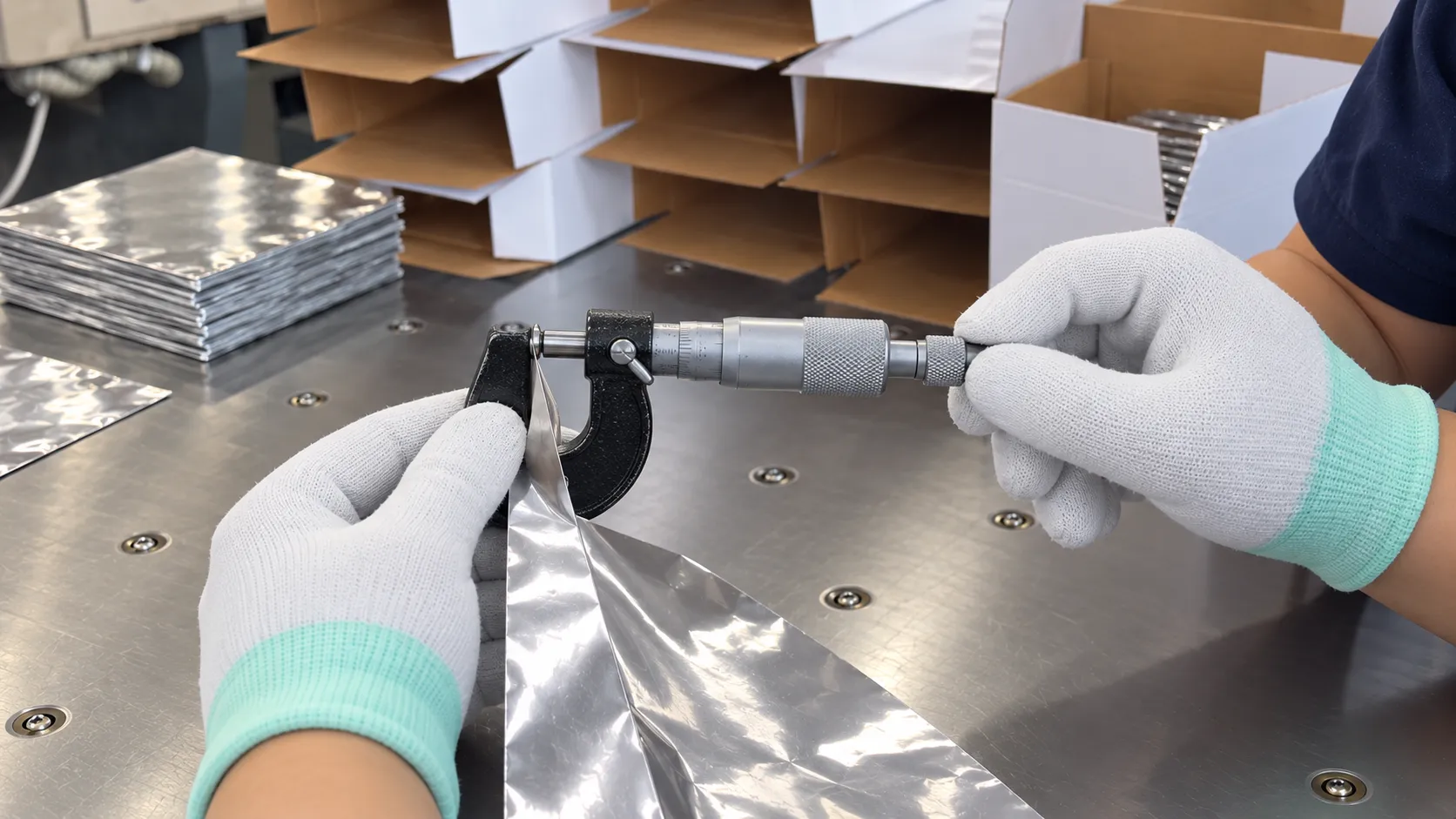
You can check a sample without a micrometer. Cut a piece of known area, weigh it, and divide the weight by the area: for a given alloy, weight per square metre is proportional to thickness. Two samples of the same size can be compared on a kitchen scale.
Alloy and temper
Hair foil is made from an aluminium alloy, not from pure aluminium. The alloys rolled into thin foil, of which 8011 is a common one, contain small additions of iron and silicon. These give thin foil more strength than pure aluminium of the same gauge.
The temper describes the condition of the metal after rolling. O temper is fully annealed: the foil has been heated after rolling so that it is soft. Soft foil folds without springing back and holds the crease that keeps a foil closed, which is what a colourist needs from it. A hard-temper foil of the same thickness would be stiffer and would not stay folded.
Our alloy and temper for each format are in the table above. A material certificate for the foil is among the documents for importing hair foil.
Thickness vs performance
Thickness changes four things that a colourist notices.
| Property | Thinner foil | Thicker foil | How we test it |
|---|---|---|---|
| Folding | Folds tight with little effort | Holds its shape; folds with more resistance | Handling on samples |
| Tearing | Tears more easily when folded wet | Resists tearing | Fold-with-bleach test |
| Comb piercing | A tail comb goes through more easily | Resists the comb tail | Comb-tail pierce |
| Weight of a wide sheet | Sags when loaded | Stays flat when loaded | Handling on samples |
Thickness is therefore matched to the size and the technique. Narrow pop-up sheets for fine weaves use the lighter end of the range. Wide and long sheets, and rolls cut into long pieces, use the heavier end. Wide and extra-wide hair foil covers the heavier sizes.
How thickness relates to warmth during processing is a separate question, covered in hair foil and heat.
Hair foil vs kitchen foil thickness
Kitchen foil and hair foil overlap in thickness, and the label “heavy duty” on a kitchen roll does not correspond to any hair foil grade. The differences that matter in the salon are the width, the cut format, the embossing and the dispensing, more than the gauge alone. Hair foil vs kitchen foil sets the two side by side.
FAQ
How thick is professional hair foil?
Professional hair foil is measured in microns (µm), thousandths of a millimetre. Hair Foil Factory makes hair foil in 12–20 µm and sets the gauge for each order: lighter for narrow sheets, heavier for wide sheets and long pieces. The figure that matters is the thickness of the metal before embossing.
What alloy is hair foil made from?
Hair Foil Factory makes hair foil from aluminium alloy 8011 in the O temper. The alloys rolled into thin foil contain small additions of iron and silicon for strength. A fully annealed temper, written O, is soft, easy to fold, and holds a crease.
Is thicker hair foil better?
Thicker hair foil is stronger, not better for every job. A heavier gauge resists tearing and a comb tail, and suits wide sheets and heavy application. A lighter gauge folds tighter and costs less per sheet, and suits fine weaves. Embossing adds stiffness without adding metal.
What thickness is best for balayage?
Balayage uses wide, long hair foil that carries more product, so it is usually made in a heavier gauge than narrow pop-up foil. Hair Foil Factory makes wide foil at the heavier end of its 12–20 µm range, or at the gauge you specify.
How do you verify foil thickness?
Hair Foil Factory measures hair foil thickness with a micrometer at several points across the sheet, recording the mean and the range. Buyers can check a sample the same way, or by weighing a sheet of known area: aluminium foil's weight per square metre is proportional to its thickness.